
The importance of knowing your counterparty in game theory
Repost from: https://medium.com/@yroclassic/the-importance-of-knowing-your-counterparty-in-game-theory-9bf7915f27eb

Reposted from my Medium (Oct 22, 2023)
In game theory, it’s not always enough to merely go with the most logical answer, you must also think deeply about what your counterparty will do, based on your presumptions about their intelligence level and personality.
Consider one of the most popular game theory questions: Guess 2/3 of the average between 0–100. For those of you who aren’t familiar with this game; If one doesn’t consider one’s counterparty, the answer would be 33. If everyone picks a random number between 0–100, the average will be around 50 and 2/3 of 50 is 33. However, taking your counterparty into account, you find out that this is the wrong answer, as they will think the same way and choose 33, so the average becomes 33 and 2/3 of 33 is 22. But they’ve also thought this far, so the average becomes 22, and 2/3 of 22 is 15. But now 15 is the average.
As you can see, the correct guess gets smaller and smaller until it arrives at 0.
So, taking your counterparty into account, the correct guess should be 0, right? But it’s not. While you have taken your counterparty into account, you haven’t determined their intelligence level, you’ve simply figured that they will all guess correctly.
The Financial Times actually held this contest in 1997, and the average guess was 18.91, so the correct answer would’ve been 2/3 of 18.91; 13.
Figuring that all other people would logically answer this question with 0, is wrong. You need to determine other things about them, like their intelligence level, personality, how serious this game is for them, etc.
Taking all these things into account, you can guess that some contestants will choose 0, some 22 and some 33. Of course you can never determine the exact average in this game, but you can get closer to the correct guess this way, instead of determining that all contestants will choose the most logical number. Bonus; you also need to take into account how many people will do exactly the same as you. If this contest was held again, a number of participants might remember that the correct guess last time was 13, so they will choose 13 again, or they will also figure out that more participants will choose 13 this time, so they will choose a number smaller than 13.
Another way to demonstrate this concept, is with one of the oldest game theory games; rock, paper, scissors.
Imagine you are playing a game of rock, paper, scissors against your friend. In the first round, both of you choose paper. In the second round, both of you choose scissors, resulting in 2 draws. Now, in the third round, what will your friend choose? If he acts out of instinct, without thinking far, he might go with rock, as he hasn’t chosen that yet. So paper is what you should choose. But maybe he thinks that you will choose rock, so he chooses paper, and scissors would be your correct choice. Or maybe, he even thinks so far that he believes you will choose paper, because he knows that you think he will choose rock, so he picks scissors, which in turn means that you should choose rock. This goes on and on. To determine what you should choose, you have to quickly determine how far ahead he will think, based on his intelligence level, which you can vaguely determine, as he is your friend.
Hint; from my experience, most people don’t think at all and choose rock, because they aren’t familiar with game theory.
How can we apply this to trading? In trading, it’s actually simpler most of the time. What you have to do is determine participants. Some possible groups of participants are; Retail (YT watchers, Spot traders, small size), Discretionary Traders (average CT trader, Perp traders, narrative traders), Funds, Hodlers/Bagholders, Market Makers.
The way we trade(short term; few hours to few days), we only really have to look at Retail and Discretionary Traders, we can leave Funds, Hodlers and Market Makers out of the equation.
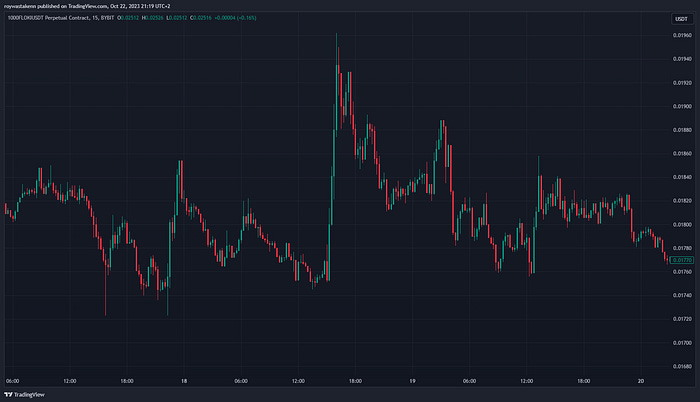
Taking the recent $FLOKI trade as an example; Floki Team hinted an announcement, which caused a sharp price increase. With the usual sell-the-news playbook, you want to see Retail (we will take this as the less intelligent participant) buying up in anticipation of the news. As sell-the-news trades are popular amont CT, Discretionary Traders will; sell the news. If you want to take this trade, you have to be on the minority side of the equation; Retail vs Discretionary Traders. In the past, Discretionary Traders have been the minority side, so the trade worked: Retail bought heavily before the announcement, the announcement comes out and they wonder why the coin didn’t move up heavily (because everyone already bought in advance), so they sell, resulting in a classical sell-the-news event.
However, once Discretionary Traders are the majority, the exact opposite happens. Everyone has shorted heavily, and once the announcement comes out, Retail might still sell off their coins, but Discretionary Traders cover their shorts, and as they are the much larger participant, price actually moves up, exactly how it did with $FLOKI, where I know many Discretionary Traders and friends got burned.
Another important thing to realize is that Retail primarily trades Spot, and Discretionary Traders trade Perps. Spot has a larger impact on price than Perps, so while there can still be less Retail Traders capital wise, their actions can still push price around more than Discretionary Traders.
If I could give any trader just one advice it would be this; Always be aware of all participants in a trade, look at the trade from their perspective and find out how they will act and what their goal is.